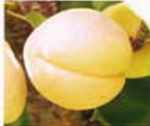
 Tilton - Excellent
variety for canning or drying with a distinctive flavor. Fruit is
medium to small and golden yellow with a dark red blush.
Self-fruitful.
Hardy to -30F (-34.4C). Self fruitful - No pollinizer needed.
Tilton - Excellent
variety for canning or drying with a distinctive flavor. Fruit is
medium to small and golden yellow with a dark red blush.
Self-fruitful.
Hardy to -30F (-34.4C). Self fruitful - No pollinizer needed.
| HOME --> All Plants and Seeds INDEX --> Trees and Shrubs INDEX --> Apricot Plants and Seeds | |
| Plant and Seed Mobile Friendly Index |
Apricots are natives of western China, where forests of wild trees still occur as far north as Siberia, where the exceptionally hardy strains are known as Russian apricots. Apricots reached England in the 13th century and traveled westward with immigrants to Virginia. They are now an important crop in the warmer areas of the US.
Culture
Apricots are not particular as to type of soil, as long as it is
well-drained,
but are very picky when it comes to cold spring winds. A northern or
western
exposure on an elevated site is best as the wind will retard blooming
until
the weather becomes warm. Apricots usually require a pollinator
to
produce fruit, though some types are self-fruitful, as noted.
Apricots are classified as 'Freestone' (the fruits receeds slightly from the seed allowing easy removal) or 'Clingstone' (the seeds are firmly attached to the fruit).
Rich's apricots are shipped with a trunk caliber of 1/2 to 5/8 inch and are grown on seedling rootstock.. If you wish to check availability before ordering, please email us at customerservice@richfarmgarden.com . If you have cultivation or other questions, please contact us at questions@richfarmgarden.com
Ripening dates below are given for USDA Zone 5.
Goldrich - Freestone. Early ripening variety with vigorous and productive trees. Fruit is mid sized and has a bright orange color. Ripens late June. Hardy to USDA Zone 5. Pollinizer needed.
| #P1434S Apricot Tree; $56.95 |
|
| #P2-1434S Apricot Two Trees for: $70.00 |
|
Harcot - A 1977 release from Vineland Horticulture Institute, Ontario. Fruit is firm with a deep golden color with a red blush. Will need to be agressively thinned for best fruit. Ripens early July. Hardy to USDA Zone 5. Pollinizer needed.
| #P2678S Apricot Tree; $56.95 |
|
| #P2-2678S Apricot Two Trees for: $70.00 |
|
Hargrande - Fruit is large and yellow-orange in color with firm flesh. Freestone. Disease resistant. Hardy and productive. Ripens mid July. Hardy to USDA Zone 5. Pollinizer needed.
| #P2679S Apricot Tree; $56.95 |
|
| #P2-2679S Apricot Two Trees for: $70.00 |
|
Moongold - Freestone. Fruits are medium in size and a glowing golden yellow. Flesh is firm and sweet, with a slightly acidic tang. Reliable bearing variety good for eating fresh, canning or freezing. Pollinating companion is Sungold. Ripens mid mid July. Hardy to -30F (-34.4C).
| #P3261S Apricot Tree; $56.95 |
|
| #P2-3261S Apricot Two Trees for: $70.00 |
|
Apricot - Prunus Armeniaca. Hardy to -30F
| #0219544 Seed Packet $11.50 |
|
| #B1-0219544 Apricot 1 lb. bulk seeds: $26.90 |
|
Rival - Early ripening type with large oval light orange fruit with a red blush. Smooth texture, low acid and has a mild flavor. Ripens mid July. Hardy to USDA Zone 5. Pollinizer needed (will not pollinate Goldrich).
| #P1435S Apricot Tree; $56.95 |
|
| #P2-1435S Apricot Two Trees for: $70.00 |
|
Sungold - Freestone. Another
University of Minnesota
introduction.
Vigorous upright growing tree. Fruits have an orange blush and
are
sweet and mild. Freestone type, good for canning, drying or
freezing.
Hardy to -30F (-34.4C). Pollinizer needed (will not pollinate
with
Goldrich).
#P1518S
| #P1518S Apricot Tree; $56.95 |
|
| #P2-1518S Apricot Two Trees for: $70.00 |
|
Tilton - Excellent
variety for canning or drying with a distinctive flavor. Fruit is
medium to small and golden yellow with a dark red blush.
Self-fruitful.
Hardy to -30F (-34.4C). Self fruitful - No pollinizer needed.
| #P1437S Apricot Tree; $56.95 |
|
| #P2-1437S Apricot Two Trees for: $70.00 |
|
ORDER EARLY!
See TERMS
Back to VARIETY INDEX Terms
HOME
 If
you have arrived in someone else's frame, or can not see all of the
other
information available on richfarmgarden.com Click on logo to enter from
beginning
If
you have arrived in someone else's frame, or can not see all of the
other
information available on richfarmgarden.com Click on logo to enter from
beginning